
ChatGPT Said My CPA Firm Is Worth $X — Why a PE QoE Review Comes In Lower
Ashley-Kincaid | September 11, 2026
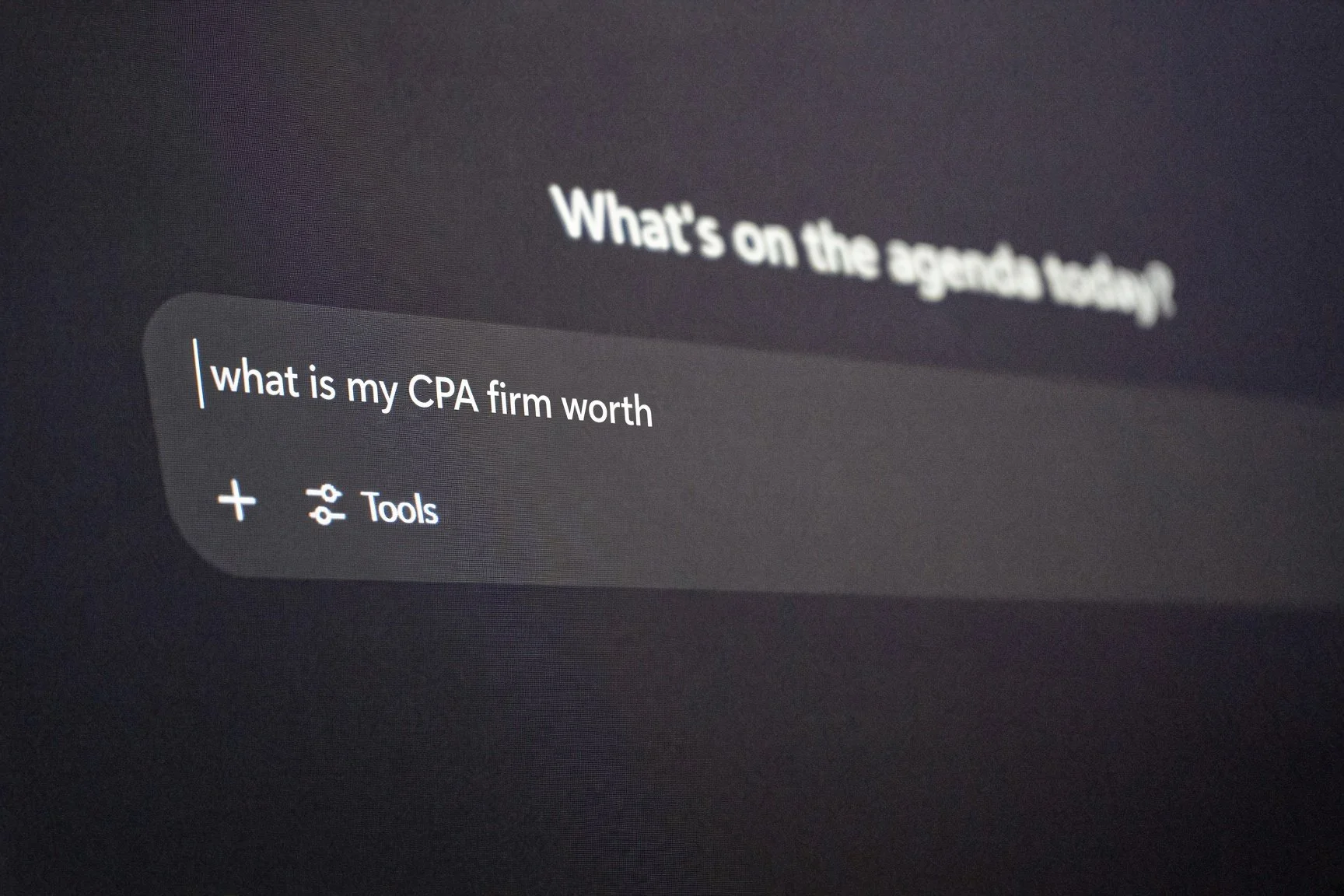
Owners now type the same question into ChatGPT, Grok, Claude, and Perplexity: What is my CPA firm worth? The tool returns a clean number — often a revenue multiple or a simple EBITDA times 4.0x–5.0x — and it feels authoritative. For many owners, that is the first valuation they have ever seen in writing. It is specific, fast, and framed with enough market language to sound like buyer underwriting.
That number is not what a private equity or strategic CPA buyer Quality of Earnings review produces.
A QoE review does not accept the firm’s story at face value. It tests whether earnings are real, recurring, transferable, and durable under new ownership. It rebuilds the P&L, challenges add-backs, normalizes owner compensation, and applies risk adjustments for concentration, retention, working capital, and key-person dependence. It also tests whether “we use AI” is a production system the firm can hand to a new owner — or a personal ChatGPT workflow that disappears when the founder steps back. Those two tests are why the buyer’s number frequently comes in lower than the AI answer.
This is not an argument against using AI tools. Used well, they help owners frame the right questions before going to market. The problem is treating a chatbot output as a substitute for how PE platforms and sophisticated strategic buyers actually underwrite CPA firms in 2026. Generic models apply average multiples to loosely defined earnings. Buyers apply a Quality of Earnings process to Normalized EBITDA, then layer qualitative adjustments and deal structure on top.
This article expands that distinction from our pillar guide: Does AI Increase or Decrease My CPA Firm’s Value If I Sell in 2026?
The goal is practical: understand why the ChatGPT number and the QoE number diverge, what a buyer file actually examines, and how serious sellers close the gap before they accept — or even solicit — an offer.
Quick Answer: Why the AI Number and the QoE Number Diverge
| Question | Direct Answer |
|---|---|
| Why did ChatGPT say my firm is worth more than PE or Others will pay? | AI tools usually apply a generic multiple to unadjusted or lightly adjusted earnings. PE QoE starts with reported numbers, then normalizes, haircuts, and applies qualitative risk adjustments. |
| Does saying “we use AI” increase the multiple? | Only if AI is in production, documented, transferable, and visible in margins, leverage, and delivery. Owner-only ChatGPT use is often treated as key-person risk, not a premium. |
| What does a QoE review actually test? | Sustainability of earnings, add-back quality, client concentration, retention, working capital, owner dependency, and whether systems survive a change in ownership. |
| Where is the buyer process explained? | In Ashley-Kincaid’s pillar: How Private Equity and CPA Firm Buyers Evaluate Quality of Earnings (QoE) in 2026. |
What ChatGPT and Other AI Tools Typically Do
Generic AI valuation answers are built from public rules of thumb and average market commentary. For CPA firms, that usually means some combination of:
0.9x–1.3x revenue for smaller practices
3.5x–5.5x “EBITDA” for mid-market firms
A single blended number with little adjustment for service mix, owner dependency, or earnings quality
Those ranges are directionally consistent with market commentary in How to Value My CPA Firm for Sale in 2026 and CPA Firm EBITDA Multiples 2026. The problem is not the range. The problem is the input.
AI tools rarely distinguish:
Reported net income vs. SDE vs. Normalized EBITDA
Owner compensation that must stay in the business vs. excess draws that can be added back
One-time items vs. recurring earnings
A firm that is transferable vs. a firm that is the owner
Buyers do. That distinction is the starting point of every serious QoE review.
What a PE Quality of Earnings Review Actually Does
A PE QoE review is not an AI summary of your P&L. It is an underwriting file. As explained in How Private Equity and CPA Firm Buyers Evaluate Quality of Earnings (QoE) in 2026, buyers and their accounting advisors typically:
Rebuild earnings from source records, not management’s headline number
Normalize owner compensation to a market-rate replacement salary
Remove discretionary, personal, and non-recurring items — and reject add-backs that cannot be supported
Test client concentration, retention, realization, and service-mix durability
Apply a conservative QoE haircut for post-close attrition, key-person risk, and integration friction
Examine working capital, WIP, and seasonality that can change the check at closing
The output is Normalized EBITDA — the earnings a professional buyer believes the firm can produce after the founder is no longer the operating system. That figure, not ChatGPT’s $X, is what gets multiplied.
The multiple itself is then adjusted for qualitative factors, as detailed in CPA Firm Valuation: Qualitative Multiple Adjustments (LBO Approach). AI sits inside those qualitative adjustments. It is not a separate valuation method.
Illustrative Gap: AI Estimate vs. PE QoE
Assume a $3.5M revenue CPA firm. The owner asks ChatGPT, “What is my firm worth?” The tool sees $900K of “profit,” applies 4.5x, and returns ~$4.05M.
A PE QoE review often starts in a different place.
| Item | ChatGPT / Generic AI Answer | Typical PE QoE Treatment |
|---|---|---|
| Starting earnings | Owner-reported profit / loosely defined EBITDA (~$900K) | Reported earnings rebuilt from books and tax returns |
| Owner compensation | Often fully added back | Normalized to market-rate replacement salary |
| AI / efficiency claims | Treated as a value premium | Counted only if documented, transferable, and visible in margins |
| QoE haircut | Usually none | Common 5–15% for attrition, key-person, and integration risk |
| Resulting earnings base | ~$900K | Often ~$650K–$750K Normalized EBITDA after adjustments |
| Multiple applied | Generic 4.5x | Quality-adjusted 3.8x–4.5x depending on risk profile |
| Illustrative enterprise value | ~$4.05M | ~$2.5M–$3.4M before structure |
The gap is not “buyers are cheap.” The gap is that the AI tool valued a founder-centric earnings story. The QoE valued a transferable business.
Why “We Use AI” Often Makes the Gap Wider, Not Smaller
The AI-valuation pillar is explicit: buyers are no longer asking whether you use AI. They are asking whether AI makes the firm easier to underwrite, integrate, and scale after closing.
QoE teams treat AI in one of two ways.
Production AI can support value when it is:
Used weekly by the team on live client work
Documented in workflows, review protocols, and exception handling
Visible in staff leverage, realization, or capacity
Running on a governed, transferable stack
Owner-only or undocumented AI can reduce value when it is:
A partner’s personal ChatGPT or custom GPT that no one else can run
Client data in consumer tools with no policy, access control, or review standard
An efficiency claim with no time studies, staffing ratios, or realization evidence
A patchwork of tools that increases integration cost
In the second category, the QoE file does not add a “tech premium.” It adds key-person risk, cyber/privacy notes, and a qualitative haircut. That is why an owner who tells ChatGPT “we are AI-enabled” can receive a higher AI estimate and a lower buyer number at the same time.
The Other Reasons QoE Comes In Lower Than the ChatGPT Number
Wrong metric. Many AI answers blur SDE and Normalized EBITDA. PE platforms underwrite mid-market firms on Normalized EBITDA. See the distinction in our SDE vs. Normalized EBITDA analysis and the valuation pillar.
Unsupported add-backs. Personal expenses, one-time items, and “AI savings” that have not shown up in the run-rate get rejected.
Service-mix durability. Heavy seasonal 1040 books are easier for others to replicate as AI compresses compliance work. Buyers underwrite that risk. Advisory and CAS mix still supports stronger multiples.
Concentration and retention. Top-client dependence and weak retention produce multiple and structure pressure regardless of software.
Working capital and WIP. QoE sets a peg. Seasonal CPA firms often see purchase-price adjustments that the AI number never modeled.
Structure is not the multiple. Even when enterprise value is close, cash at close, rollover, earnouts, and notes change net proceeds. Compare packages using CPA Firm Deal Structures in 2026 and PE vs Strategic Buyer.
Fund timing and underwriting discipline. Where a PE fund sits in its lifecycle affects how aggressive it will be on earnings and structure. See Understanding the Private Equity Fund Lifecycle.
How Serious Sellers Close the Gap Before Going to Market
Rebuild Normalized EBITDA the way a buyer will — market-rate owner salary, documented add-backs, conservative haircut.
Separate production systems from personal AI. If only the founder can run the workflow, it is not an asset in diligence.
Document where AI sits in tax, CAS, bookkeeping, and review: who uses it, who reviews output, how exceptions are handled.
Produce the reports buyers expect quickly: client-level profitability, realization, retention, and service mix.
Clean governance: approved tools, access controls, client-data policy, and professional-liability posture.
Decide whether the firm is being positioned as a platform or an add-on. That choice changes both multiple and structure.
Model net proceeds, not headline value. A lower QoE number with 60% cash can beat a higher AI number with heavy contingency.
Questions to Ask Before You Trust the $X
What earnings definition did the AI tool use — net income, SDE, or Normalized EBITDA?
Did it apply a replacement-salary adjustment and a QoE haircut?
Is our AI transferable, or is it founder-dependent?
What would a buyer’s QoE provider reject on first review?
How would PE vs. a strategic buyer treat the same earnings and the same tech stack?
What cash at close, rollover, and earnout mix is likely against that earnings base?
Those questions belong in a sell-side process, not in a chatbot thread.
Bottom Line
ChatGPT can give you a number. A PE Quality of Earnings review gives you the number a buyer will fund, structure, and live with after closing. The second number is usually lower when the first number was built on unadjusted earnings, generic multiples, and an undocumented AI story.
The gap is closable. Firms that present clean Normalized EBITDA, transferable systems, and documented production AI do not need the chatbot valuation. They already look like the firm buyers want to underwrite.
Ashley-Kincaid works exclusively with serious CPA firm owners who want buyer-ready earnings and a structure that matches their goals. If you have an AI-generated value in hand and want to know what a PE QoE file would actually support, a confidential assessment is the next step.